

How AI, SEO, and Social Media Are Reshaping Modern Marketing
Digital marketing is evolving rapidly as technology changes the way businesses communicate, compete, and build relationships with customers. Traditional advertising once depended heavily on television, newspapers, radio, and outdoor campaigns. Today, consumers discover brands through search engines, social platforms, websites, videos, online communities, and personalized digital experiences. This transformation has made marketing more immediate, measurable, interactive, and customer focused.
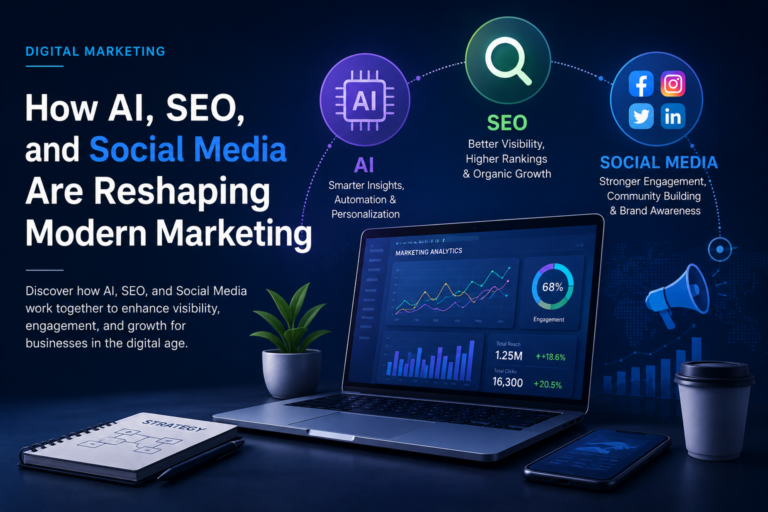
Among the forces driving this change, Artificial Intelligence, Search Engine Optimization, and social media have become especially important. AI helps marketers analyze information, automate tasks, and create personalized experiences. SEO helps businesses become visible when people search for answers, products, or services. Social media enables direct communication, community building, storytelling, and engagement. Together, these areas are reshaping how modern businesses attract attention and create long term value.
The role of Artificial Intelligence in marketing has expanded significantly. AI can process large volumes of information faster than people, identify patterns, support research, and automate repetitive activities. Marketers can use AI tools to brainstorm ideas, organize customer information, summarize trends, create initial content drafts, improve workflows, and analyze campaign performance. This can save time and allow professionals to focus more energy on strategy, creativity, and decision making.
Personalization is one of AI’s most powerful contributions. Customers increasingly expect relevant experiences instead of generic messages. AI can help businesses understand browsing behavior, previous purchases, content interests, and customer interactions. These insights can support personalized recommendations, targeted communication, product suggestions, and content experiences. When personalization is useful and respectful, it can make customers feel that a brand understands their needs rather than simply broadcasting advertisements.
AI also supports customer service through chatbots and automated assistants. These systems can answer common questions, guide visitors through websites, and provide assistance outside normal business hours. Automation does not need to remove human interaction. Instead, it can handle routine requests while employees focus on complex problems that require empathy, judgment, or specialized knowledge. The strongest customer experiences often combine efficient technology with accessible human support.
However, AI is not a replacement for every marketing skill. Artificial intelligence can generate possibilities, but it does not automatically understand a company’s values, cultural context, audience emotions, or long term goals. Marketers still need to check accuracy, maintain brand voice, make ethical decisions, and decide whether generated ideas are genuinely useful. Human creativity and strategic thinking remain essential for turning technology into meaningful communication.
SEO is another major part of the changing marketing landscape. Search engines remain an important starting point when people want information, compare options, solve problems, or discover businesses. A strong SEO strategy can help a website reach audiences at the moment they are actively looking for relevant answers. This makes search visibility valuable for businesses of different sizes and industries.
Modern SEO is about much more than repeating keywords. Effective optimization begins with understanding search intent. A person searching for a basic definition has different needs from someone comparing services or preparing to make a purchase. Businesses need content that matches these different needs while remaining clear, accurate, and useful. High quality articles, product pages, guides, and helpful resources can create value for visitors while improving a website’s overall relevance.
Technical quality also matters. Websites should load efficiently, work well on mobile devices, provide clear navigation, and make important information easy to access. Good user experience supports both visitors and long term marketing goals. If a website is confusing or slow, users may leave before discovering the value a business offers. Therefore, SEO should be connected with web design, content strategy, accessibility, and customer experience.
The growth of AI is also influencing search behavior. People increasingly interact with search technology through conversational questions and more detailed requests. This means marketers should think beyond isolated keywords and focus on topics, problems, and audience needs. Creating content that answers real questions can be more valuable than producing pages designed only to repeat popular search phrases.
For example, instead of focusing only on a broad phrase such as digital marketing, a business can explore the questions behind that topic. What challenges do small businesses face online? How can a website attract qualified visitors? Which marketing channels are suitable for a specific audience? By answering useful questions clearly, brands can demonstrate expertise and create content with a stronger purpose.
Social media adds another dimension to modern marketing. It has changed communication from a one way process into an ongoing conversation. Businesses can publish content, receive feedback, answer questions, participate in discussions, and build communities around shared interests. This direct connection gives brands opportunities to become more approachable and responsive.
Successful social media marketing is not simply about posting advertisements every day. Audiences usually respond better when brands provide information, entertainment, inspiration, education, or useful solutions. A short video can explain a product. A carousel can teach a process. A behind the scenes post can make a company feel more human. A thoughtful response to a comment can strengthen trust. Different formats can serve different purposes within a broader content strategy.
Video has become especially influential because it can communicate ideas quickly and combine visual storytelling with personality. Short form content can capture attention, while longer videos can explain complex topics and build deeper understanding. Businesses should choose formats based on their audience and objectives rather than following every trend without a clear reason.
Social media also provides valuable feedback. Comments, shares, saves, messages, and other forms of engagement can reveal what audiences find useful or interesting. These signals should not be treated as the only measure of success, but they can help marketers understand how content is performing. Combined with website analytics and search data, social insights can support stronger decisions about future campaigns.
The greatest opportunity appears when AI, SEO, and social media work together. These areas should not exist as isolated marketing activities. AI can support research and identify possible audience questions. SEO can help organize those insights into useful website content. Social media can distribute that content, encourage conversation, and bring additional visitors to a brand’s digital presence.
Consider a business creating a campaign around a common customer problem. AI assisted research may help identify recurring questions and content themes. The marketing team can then create a detailed, useful article optimized around relevant search intent. After publishing it on the website, the business can adapt the main ideas into short videos, graphics, posts, and discussions for social channels. Feedback from the audience can then inspire improvements or new content. This creates a connected cycle instead of a collection of unrelated activities.
Data plays an important role in this process. Websites, search campaigns, and social platforms can provide information about audience behavior and content performance. Marketers can examine which pages attract visitors, which topics generate engagement, and where users leave a customer journey. AI can help process large datasets and identify patterns, but people must decide what those patterns mean for the business.
Responsible data use is equally important. Personalization should not become intrusive, and businesses must consider privacy, transparency, and customer trust. Technology gives marketers greater capabilities, but those capabilities should be used carefully. A successful digital strategy is not only about reaching more people; it is also about building confidence and respecting the audience.
Another important change is the growing value of authenticity. Digital audiences are surrounded by advertising and have many options for comparing brands. As a result, clear messaging and genuine communication can become important advantages. Businesses should understand their identity and communicate consistently across websites, search content, and social channels.
A strong brand voice can help create recognition, but consistency does not mean repeating identical messages everywhere. A website article, a social video, and an email can have different formats while still reflecting the same values and personality. Marketers need to adapt content to the context while maintaining a recognizable brand experience.
Human creativity remains central to this work. AI can accelerate research and production, but memorable marketing often comes from insight, storytelling, empathy, and original thinking. People understand humor, culture, emotion, and relationships in ways that automated systems cannot fully reproduce. The future is likely to reward marketers who combine technological skills with strong communication and critical judgment.
Businesses must also be willing to learn continuously. Digital platforms, customer expectations, and search technologies can change quickly. A strategy that worked several years ago may need adjustment. Rather than chasing every new tool, marketers should understand their goals and test technologies that genuinely support those goals.
Investing in a strong website remains especially important. Social platforms are valuable for discovery and engagement, but a website gives a business greater control over its information, content, and customer experience. SEO can help bring relevant visitors to that digital foundation, while social media and other channels can support awareness and relationships.
The future of marketing will therefore be increasingly connected. AI will make research, automation, and personalization more accessible. SEO will continue to evolve as search behavior and technology change. Social media will continue connecting brands with audiences everywhere.